A research team led by Professors Ouyang Zhen and Wei Yuan of the School of Pharmacy of Jiangsu University (JSU), working with Prof. Guo Juan of the National Resource Center for Chinese Materia Medica, China Academy of Chinese Medical Sciences, has reported a significant advance in the biosynthesis of 1-deoxynojirimycin (DNJ) in mulberry leaves. The findings were published in the Journal of Agricultural and Food Chemistry under the title “Elucidation of the Hydroxylation Sequence in 1-DNJ Biosynthesis through Stable Isotope Tracing and Enzymatic Characterization,” and were selected as the journal’s cover article. JSU is the first affiliation; PhD student Fan Jiahe is the first author, and Ouyang Zhen and Guo Juan are the co-corresponding authors.
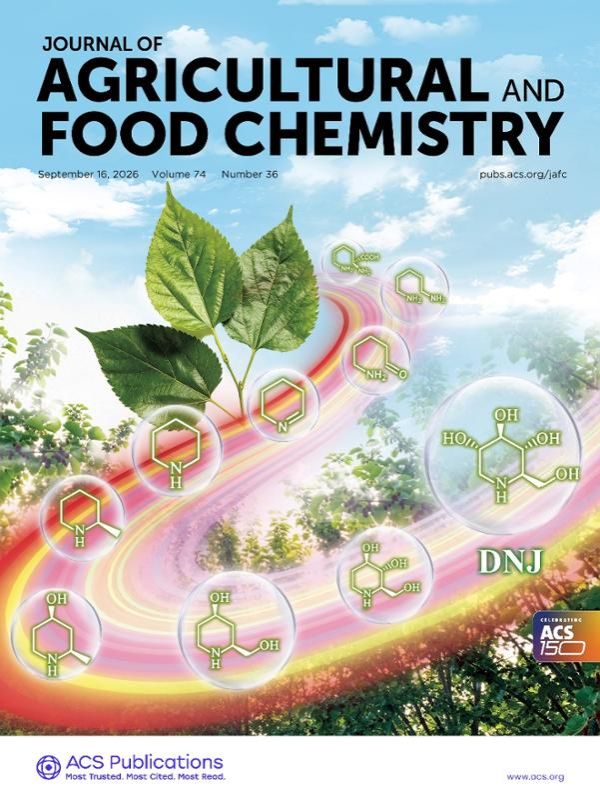
DNJ is a characteristic polyhydroxy alkaloid found in mulberry leaves. As a potent α-glucosidase inhibitor, it has a range of pharmacological activities, including lowering blood glucose, regulating blood lipids and anti-HIV effects. However, its low abundance in mulberry leaves, the difficulty of extraction and isolation, and the complexity and low yield of chemical synthesis have limited its large-scale production. Mapping the DNJ biosynthetic pathway and applying synthetic biology offer an important route to green, efficient production.
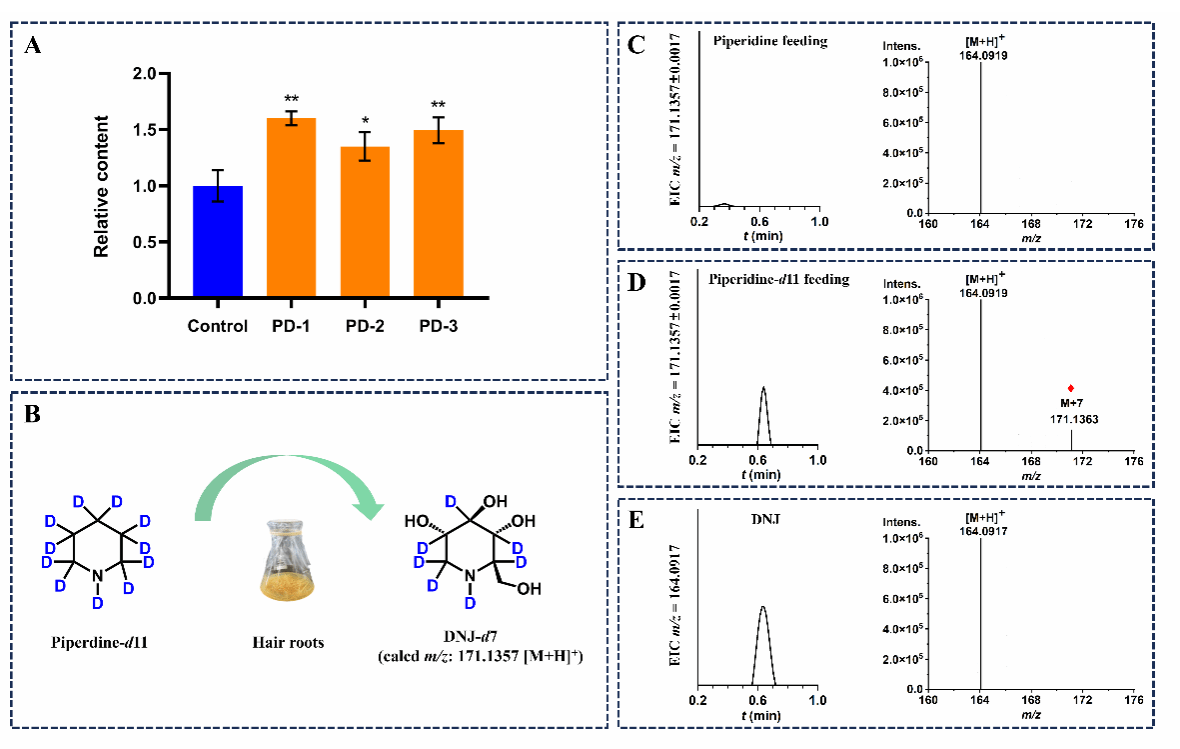
DNJ belongs to the lysine-derived polyhydroxy piperidine alkaloids. The team had previously mapped the upstream pathway from L-lysine to 2-methylpiperidine, but the downstream hydroxylation steps remained unclear: neither the catalytic order of the hydroxylation sites nor the key intermediates were well defined, which hindered the rational design of microbial cell factories for DNJ production. In this study, the team fed deuterium-labeled piperidine-d11 to mulberry hairy roots and detected the isotope-labeled product DNJ-d7, confirming piperidine as a key precursor of DNJ biosynthesis. Combining yeast whole-cell catalysis, microsomal in vitro enzymatic assays and transient expression in Nicotiana benthamiana, the study showed that the downstream hydroxylation reactions proceed in the order C-4→C-7→C-3→C-5: that is, (R)-2-methylpiperidine is hydroxylated successively at C-4, C-7, C-3 and C-5 to form DNJ.
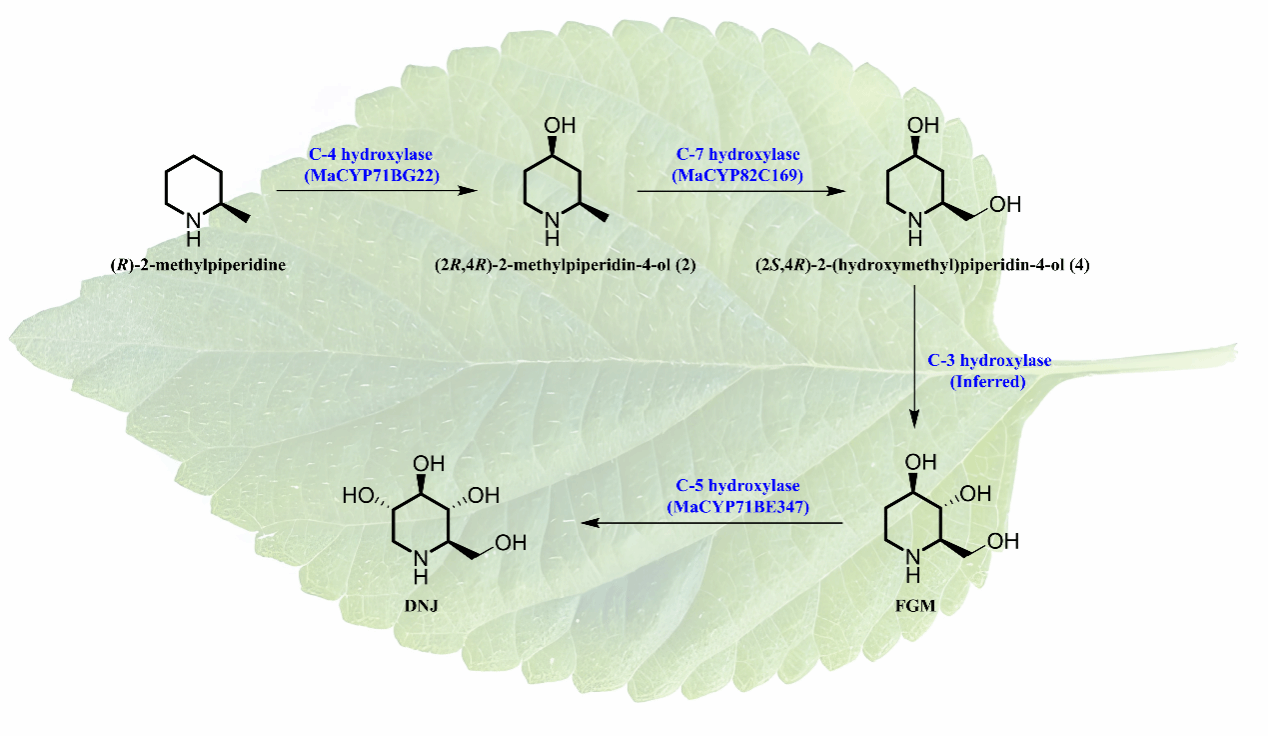
The study clarifies the key intermediates and the reaction sequence in the hydroxylation process, providing a basis for the heterologous biosynthesis and metabolic engineering of DNJ.
(Source: School of Pharmacy)
Article link: https://doi.org/10.1021/acs.jafc.6c03778