Prof. Liu Yunjian’s team at the School of Materials Science and Engineering of Jiangsu University (JSU) has published a research article in eScience, a leading international journal in the energy field, titled “Nano-framework electroplating enabled by chloride electrolyte engineering for long-life and high-reversibility aqueous zinc-ion batteries.” The work was carried out with the School of Materials Science and Engineering of JSU as the first affiliation. PhD student Li Teng and international faculty member Ahmad Naveed are co-first authors, and Prof. Liu Yunjian and Prof. Wan Yangyang of JSU and Prof. Li Chengchao of Guangdong University of Technology are co-corresponding authors.
Aqueous zinc-ion batteries (AZIBs) are one of the most promising pathways for large-scale energy storage, prized for their outstanding safety and cost-effectiveness. However, aqueous electrolytes are prone to zinc dendrites, interfacial passivation and hydrogen evolution side reactions, which substantially limit cycle life and reversibility. Although high-concentration chloride salt electrolyte modification has been used as a remedy, it is highly toxic and costly, and Cl- can exacerbate electrode corrosion. Overcoming this trade-off, and optimizing the electrolyte and interfacial structure with low-concentration Cl- while avoiding its corrosive effects, has been a key challenge in advancing AZIB performance.
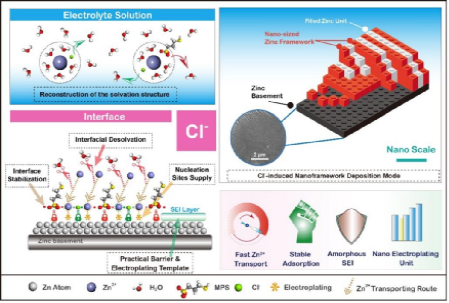
To address these challenges, the team developed a composite electrolyte modification strategy that combines low-concentration Cl- with sulfonate salts (MPS). The two components work together to create a stable and controllable design for the zinc electrode interface. The study shows that Cl- can restructure the hydrogen-bond network of water and the Zn2+ solvation structure, enhance ion-transport kinetics and distribute the electric field uniformly at the electrode interface, providing abundant nucleation sites for uniform zinc deposition. MPS additives, meanwhile, work with Cl- to form -SO3--Zn2+-Cl- interfacial adsorption complexes and an amorphous SEI interface, effectively preventing interface corrosion. The two mechanisms act in synergy to suppress water-induced side reactions and boost reversibility. Electrochemical tests show that the modified system achieves an ultra-high average coulombic efficiency (CE) of 99.80%.
In addition, the -SO3--Zn2+-Cl- interfacial adsorption complex array formed in situ at the interface induces a unique deposition mode, enabling uniform and dense stacking of zinc nano-units. This significantly addresses the disordered deposition and dendrite formation seen in conventional systems. Under extremely harsh conditions (15 mAh cm-2, 51.2% depth of discharge (DOD), electrolyte-to-capacity ratio (E/C ratio): 4.7 μL mAh-1), the battery cycles stably for more than 430 hours. As a proof of concept, the assembled V2O5-x full cell retains up to 96.1% of its capacity after 1,600 cycles. Moreover, thanks to the accelerated zinc deposition mechanism enabled by interfacial Cl- ion bridging, the full cell delivers an excellent specific capacity of 450 mAh g-1 at a high current density of 10 A g-1, demonstrating exceptional cycling stability and rate performance.
This study challenges the traditional understanding that low-concentration Cl- is detrimental to aqueous batteries. By developing a modified strategy based on the synergy of low-concentration salt and MPS, it offers a new design approach for interface regulation and solvation optimization in aqueous batteries, helping to advance the industrial development of long-life, high-safety and low-cost energy storage batteries.
Article link: https://doi.org/10.1016/j.esci.2026.100613
(Source: School of Materials Science and Engineering)