Faculty and Students from the School of Food Science and Engineering Published Breakthrough Findings in Top Plant Science Journal New Phytologist
Researchers led by Prof. Zhang Hongyin from the School of Food Science and Engineering at Jiangsu University (JSU) have published groundbreaking research in New Phytologist, one of the world’s most prestigious peer-reviewed plant science jounals. Titled "Apple ZAT11, a C2H2-type zinc finger protein, enhances resistance to Penicillium expansum by affecting jasmonic acid biosynthesis in apple", the paper reveals a previously uncharacterized molecular mechanism through which apples resist postharvest blue mold, a dustructive fungal disease.
Caused by Penicillium expansum, blue mold is the most common and destructive postharvest disease affecting apples, triggering 15–20% storage-related fruit losses. Identifying fruit resistance genes and clarifying their regulatory mechanisms is vital to developing green, sustainable postharvest disease control strategies. The plant hormone jasmonic acid (JA) plays a central role in plant defense against necrotrophic pathogens, yet the transcription factors directly regulating JA biosynthetic genes had not been identified prior to this study.
MdZAT11 acts as a key positive resistance regulator
Ttranscriptome screening and phylogenetic analysis identified MdZAT11, a C2H2-type zinc finger protein gene strongly upregulated in the early stages of P. expansum infection. Subcellular localization tests and yeast self-activation assays verified MdZAT11 localizes to cell nuclei and has no self-driven transcriptional activation activity.
Agrobacterium-mediated transient overexpression assays on apple fruit show MdZAT11 significantly reduces lesion size and disease incidence, while upregulating the defense marker gene MdPR4, confirming MdZAT11 positively regulates apple resistance to P. expansum.
MdZAT11 directly activates JA biosynthesis genes
Combining transcription factor-centered yeast one-hybrid (TF-centered Y1H) screening and RNA-seq integrative analysis, the team identified 1,059 potential target genes of MdZAT11. Upregulated genes were highly enriched in the alpha-linolenic acid metabolism pathway, the gateway to JA biosynthesis.
Four core JA biosynthetic genes — MdAOS, MdAOC, MdLOX6, and MdLOX3.1 — were identified as direct targets. Electrophoretic mobility shift assays (EMSA) and dual-luciferase reporter (DLR) assays confirmed that MdZAT11 directly binds to the promoters of these four genes and activates their transcription. Transient overexpression of MdZAT11 in apple fruit led to upregulation of all four JA biosynthetic genes and a significant increase in endogenous JA content.
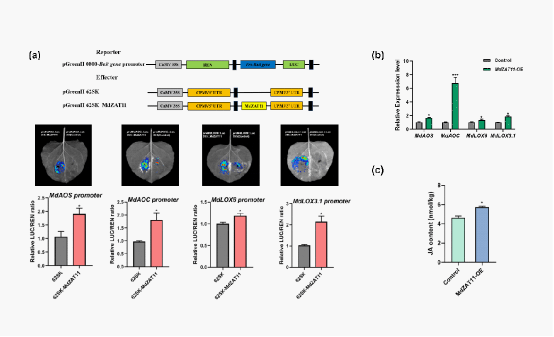
Figure 1. MdZAT11 directly binds to and activates the key JA biosynthetic genes MdAOS, MdAOC, MdLOX6, and MdLOX3.1.
The study further established a working model for MdZAT11-regulated resistance in apple: upon P. expansum infection, MdZAT11 expression is induced. MdZAT11 then directly binds to the promoters of MdAOS, MdAOC, MdLOX6, and MdLOX3.1, activating their transcription and promoting JA accumulation, which in turn activates downstream defense gene expression and ultimately enhances apple fruit resistance to P. expansum.
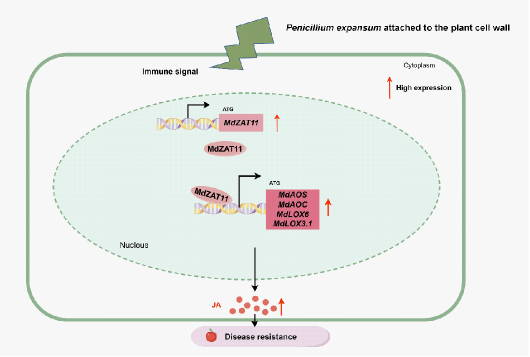
Figure 2. A working model illustrating the role of MdZAT11 in enhancing apple resistance to P. expansum via JA biosynthesis.
Upon P. expansum infection, MdZAT11 is transcriptionally upregulated. MdZAT11 directly binds to the promoters of JA biosynthetic genes (MdAOS, MdAOC, MdLOX6, and MdLOX3.1) and activates their expression, leading to elevated JA levels. Increased JA content subsequently activates downstream defense responses, including the expression of defense-related genes such as MdPR4, conferring enhanced resistance against the pathogen.
Article link: https://doi.org/10.1111/nph.71312
(Source: School of Food Science and Engineering)